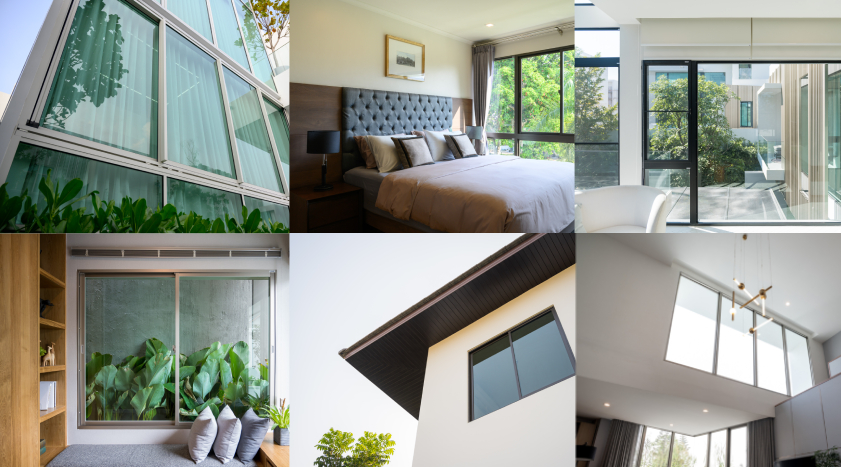

Casement and Sliding windows are the 2 most common styles of windows.
The Casement windows swing open like a door. The opening part (sash or palla) is fixed with a frame on one side using hinges and on the other side has a lock or a latch arrangement. Old houses usually have a wooden casement window, with either glass or wooden shutters. Casement windows can be single or multiple units which are fixed side by side. Some part of the window may also have fixed glass. The window can be side opening or top opening (awning). It can be outside opening or inside opening.
The Sliding Window is relatively newer, with the advent of high rise buildings. The opening is created by moving the sash to one side. The sash has rollers which move on a track at bottom and is supported on the upper side. When all sash is closed, it is locked at the centre or at the side of the frame.
Selection of window design is usually done by an architect. A comparison of both types of windows is given below for the benefit of the house owner.
Casement Vs. Sliding Window
The Casement window is more suited for low rise buildings. Though there is no evidence, some architects believe Casement Windows are not suited for high rise, due to the risk of accidents if a sash falls down in high wind. It is also thought that leaning-out to close a Casement Window is more risky in a high rise building.
The sliding windows are used equally in high rise buildings and low rise buildings. Some architects believe that Sliding Window gives a flush look to a high rise building, whereas Casement Window gives an irregular look as few sash will be open & some closed.
Common Materials
Casement Window is most common in wood, but can be made equally well with other materials like steel, UPVC and aluminium. In hilly areas, very complex & beautiful window are made with wood and stained glass. Circles and arch are very common, as wood can be crafted to various shapes.
The Sliding Window is very difficult to make with wood, since track & roller arrangement is really difficult for a carpenter to fabricate using hand tools. The window also becomes bulky and has a tendency to warp / get jammed, unless seasoned hard wood is used which is very expensive.
Must Read: Top 10 Features And Benefits Of Casement Windows
The Sliding Window can be made more easily using UPVC or aluminium, as both are engineering materials and hardware can be fitted easily. The aluminium windows have the additional benefit of looking more slim as compared to other materials.
Design options
The Casement Window can be a single window or multiple windows. In India, windows are mostly outside opening as it does not intrude space. In Europe, inside opening windows are more popular and are mostly kept partly open due cold weather. It also makes cleaning of glass easier. In outside opening windows, cleaning outside glass is possible by using an offset hinge, which leaves a gap to clean by hand. Insect screens can be easily provided and there are many designs.
The sliding Window can have fixed glass, above or below the moving sash, depending on the architect’s design. The number of moving sash can be 2,3, 4, 6 or 8 depending on the width of window and number of tracks. More sash means, more open area, but there are design limitations. Insect screens can be easily provided.
Sliding windows have a limitation for minimum width. For instance bathroom windows have less width where casement or awning windows are more suitable. Other parts of the window house may also have a similar design. It is very common to see both Casement and Sliding Window used in the same building.
Size limitations
The Casement sash width is limited by the length of the human hand to open & close the window. The height is proportionate, mostly starting 30” from floor for safety. Overall size is not so big, though it is possible to have a string of casement windows in a row. A manual cranking mechanism is supplied by Tostem to safely operate and close the window. A child safety latch is also available to reduce window opening and reduce risk of an accident.
The major benefit of sliding windows is that sash size can be very large. Height up to 4.5 m and width up to 6 m is easily possible. The size of sash is dependent on wind load and location of building.
Performance in harsh weather
The Casement window has better weather resistance as there are no air gaps. Performance is better if multi point locks are used to hold sash tightly.
The Sliding Window uses bottom rollers and inherently there are more air gaps. However there is no impact on monsoon performance, as water is drained through the bottom track. Noise reduction is marginally less as compared to Casement Window.
Conclusion
The choice between Casement and Sliding window is usually exercised by the architect at time of designing the window. The building look is greatly defined by size and style of windows. Both kinds of windows can be used as the consideration is mostly based on aesthetics.
FAQs
Which is better, casement window or sliding window?
The choice depends on your needs. Casement windows offer better ventilation and a tighter seal, while sliding windows are space-saving, easy to operate, and great for modern designs.
Which window is best, sliding or open?
Sliding windows are ideal for compact spaces and ease of use, while openable windows, like casement windows, provide better airflow and a secure seal.
What is a casement window?
A casement window is a type of window that is hinged on one side and opens outward like a door. It provides excellent ventilation and energy efficiency.
What is a sliding window?
A sliding window consists of panes that glide horizontally along a track. It is space-saving, easy to use, and suitable for contemporary homes.
How to open a sliding window from the outside?
To open a sliding window from the outside, you would typically need tools to disengage the latch or lock. Note: Doing so without permission is unauthorized and could violate the law.
How to unlock a sliding window from the outside?
Unlocking a sliding window from the outside generally requires specialized tools to manipulate the lock or latch. Ensure you have proper authorization to do so, as it may be illegal otherwise.