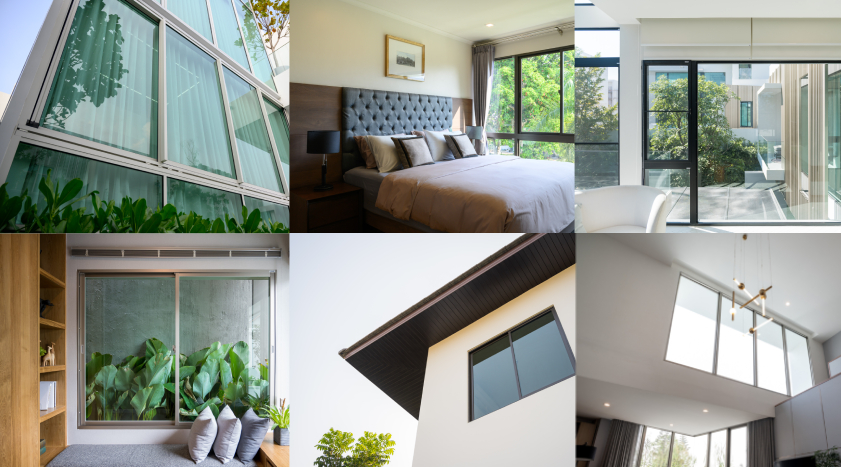
Glass is one of the earliest man-made materials and was considered a luxury product in early times. Usage of glass for windows started nearly 2000 years ago. Since initially optical properties were not good, stained glass with lead joints became popular as seen in old churches in Europe. The quality slowly improved with the development of cast plate glass, but large sheets could still not be produced, and old windows often have multiple joints giving a grid look, which is a characteristic feature of aluminium window glass design during that era.
The glass used today is ‘float glass,’ which has uniform thickness, better transparency, and good optical properties. It can be produced in any length and is the preferred choice for modern aluminium window glass. Major suppliers in India include Saint Gobain, Guardian, and Asahi. These companies make clear glass in different thicknesses. Normal float glass, also called annealed glass, is available in glass shops across India and is commonly used in aluminium window glass installations.
Two other grades of glass are made by glass manufacturers. Tinted float glass or colored glass is used to reduce the effect of solar radiation, but the light transmission efficiency is also reduced. This is often considered the best glass for aluminium windows in areas where sun exposure is high. Coated float glass has a thin surface coating, which reflects radiant heat, but light transmission properties are retained. It is very useful in a hot country like India and makes it a popular choice for sliding window glass types in homes and offices.
Other grades of glass manufactured in India include: a) Patterned or Rolled Glass, which is used for decorative purposes; b) Wired Glass, which is used for fire safety; and c) Extra Clear Glass, which is used in high-end applications for clarity and high colour-rendering properties. These glass types are also increasingly used in aluminium window glass design to offer both aesthetic appeal and functional advantages.
Processed Glass
The big challenge faced by the window industry is that glass has to be cut to the actual size of the window. This work is done by processors, also available in all parts of the country. Processors convert annealed float glass to different grades (e.g., safety glass), as needed for residential use. The secondary manufacturing process is guided by the Federation of Safety Glass; the process is detailed here. Processed glass is also covered under IS 2553 (Part 1): 2018. Different aluminium window glass designs require specific glass types for enhanced performance, depending on the aesthetic and functional requirements.
Common Types of Processed Glass Used with Aluminium Windows
Retail aluminium window glass requires either a single glass or double glass sealed units. It is commonly believed that insulated / double glass units will have higher performance, which is not generally true. For instance, a single laminated glass will reduce more sound compared to normal double glass. Choosing the best glass for aluminium windows depends on the desired attributes like sound insulation, safety, and thermal performance.
It is believed that double units are filled with an inert gas for improved performance, but this use is very rare as it does not offer much benefit. The real benefit of sealing is that moisture does not enter inside in the wet season and dew condensation is avoided. For sliding window glass types, it’s essential to understand that not all glass configurations are ideal for the design and movement of sliding windows.
1. Tempered or Toughened Glass (Processed from Float Glass)
As the name suggests, toughened glass is 4-5 times stronger than annealed glass and performs better against sudden changes in temperature. It is more difficult to break and finally splinters into very small fragments, which can cause less harm (normal glass breaks into shards, which can be very dangerous). Toughened glass is the minimum specification glass recommended for use in residential buildings and commercial projects, including aluminium window glass applications.
The manufacturing process for tempered glass involves heating glass to 650º C and moving it back & forth inside a furnace. Cooling is achieved by sudden air quenching, which gives glass the toughening property. The movement on rollers does create undulations on the glass surface, which is permitted under FOGS guidelines. This type of glass is often used in aluminium window glass design to meet both safety and durability standards.
2. Laminated Glass (Processed from Float Glass)
The market is now shifting towards laminated glass due to better properties. As the name suggests, 2 sheets of glass are bonded together with a layer of polyvinyl butyral (PVB) film in between. The rubber-like PVB clear film holds both sheets of glass together. In case of glass breakage, the glass fragments remain stuck to the film and cause less injury (as in car windshields). It is also possible to use more than one layer of PEB film, which further improves glass performance. Laminated glass is often considered the best glass for aluminium windows when safety, sound reduction, and UV resistance are critical factors.
The key benefits of laminated glass are user safety during glass breakage and the ability to sustain impact in case of intrusion. Interestingly, the PVB layer is also an excellent sound barrier, which is an advantage in high-traffic areas. It also has high UV resistance. It stops UV rays and does not discolor over a long period of use. In case the strength of laminated glass is to be improved, the glass used can be toughened, or the number of glass & PEB layers can be increased. Progressively, even bulletproof glass can be achieved.
Additional read :- Wonderful Window Designs To Beautify Your Home Interiors
3. Insulated Glass Unit (IGU) (Processed from Float Glass, Toughened Glass, or Laminated Glass)
Insulated glass units (IGU) are made of 2 or 3 layers of glass panes mechanically held together with a 10-12 mm air gap, using spacers around all 4 edges. The spacer is a hollow tube filled with desiccant material which absorbs any air that enters inside. The spacer is hermetically sealed so that the inside air remains dry, preventing dew formation.
The main benefit of an IGU unit is that it reduces heat transmission through the window, as air is a bad conductor of heat. The IGU unit can only stop air-to-air transmission of heat, but radiation heat will still pass through. This can be reduced by using low-e glass, which will reflect the heat back into the atmosphere. The IGU unit is universally used in high-cold regions, where the goal is to retain heat inside (prevent heat loss through glass). This type of glass is often used in aluminium window glass design for its excellent energy efficiency.
During the monsoon, IGU helps reduce condensation of water on the outside glass surface. This is because only the inside glass pane becomes cold due to the impact of air-conditioning, but the outer surface remains at ambient temperature. Double glazing offers some benefit in noise reduction. If the two glass panes are of different thickness, the noise reduction improves significantly. Further improvement is possible if one of the panes is laminated glass.
Benefit of Glass Processing
Float glass needs further processing to improve performance against high winds, increased safety, ultraviolet filtration, sound absorption, energy efficiency, and fire safety. It may be remembered that all properties cannot be given in a single glass. It is important to decide which property is most desirable, as cost will constantly increase. Higher performance glass, like laminated, has more weight, which impacts the roller capacity of the window. The total cost of glass, plus a higher specification for the window, becomes quite high. This is particularly relevant when selecting sliding window glass types, as the weight of the glass directly influences the ease of sliding and durability of the window frame.
One downside of processed glass is that it cannot be cut or resized. This benefit is available only with normal annealed glass. For more flexible window designs, particularly when dealing with sliding window glass types, it’s crucial to consider the design and function of the window in relation to the glass.
Conclusion
There are many different types of glass that can be used for aluminium windows glass, each with its advantages and disadvantages. Ultimately, the best glass for aluminium windows will depend on your specific needs and preferences. Whether you’re looking for enhanced safety, noise reduction, or better thermal performance, the right aluminium window glass design can make a significant difference in the overall functionality and appearance of your windows.
FAQs
What is the best glass for aluminium windows?
The best glass for aluminium windows depends on your needs. Laminated glass is great for safety and noise reduction, while insulated glass units (IGUs) are ideal for energy efficiency and thermal insulation.
What is laminated glass?
Laminated glass consists of two glass layers with a PVB interlayer. It offers superior safety, noise reduction, and UV protection, making it ideal for aluminium window glass.
What’s the difference between laminated and toughened glass?
Laminated glass is safer, holding fragments together upon impact, while toughened glass is stronger and more heat-resistant but shatters into small pieces upon breakage.
Are insulated glass units (IGUs) good for aluminium windows?
Yes, IGUs are commonly used in aluminium windows for improved thermal insulation and energy efficiency. They help reduce heat transfer and condensation.
How do I select the right glass for aluminium windows?
Choose glass based on performance needs—toughened glass for safety, laminated glass for noise reduction, and IGUs for better insulation and energy efficiency.